
Nitrogen-based cutting is primarily a “melt-and-eject” cutting process. Since nitrogen is inert, the laser supplies the energy to melt the material, and high-pressure assist gas blows the molten metal out of the kerf.
The result is lightning-fast cutting – where the cycle time is driven by the motion dynamics of the laser (speed and acceleration) rather than laser power. In this video, you can see the Fairmont RevolutionX cutting sheet material at 7.5 holes per second using nitrogen assist gas. This cutting of small holes is the best test of machine dynamics because the laser head is constantly accelerating, while not limited by power.
Nitrogen leaves a clean edge with no oxidation, almost no taper, and effectively no heat-affected zone – allowing holes to be tapped right off the machine without secondary processing.
But nitrogen-based cutting is limited by material thickness. Since the laser itself is providing the cutting energy, low-power nitrogen cutting has long been limited to gauge material. With power now rising up to 60 kW, nitrogen cutting can cut as thick as 1.5” and sometimes even 1.75″ – but still cannot touch the 3″ thickness of oxygen cutting at 60 kW.
There are three subgroups of nitrogen-based cutting: pure nitrogen, mixed gas, and compressed air. Each provides its own slight advantages and disadvantages when cutting carbon steel.
Pure Nitrogen Cutting
Pure nitrogen cutting is used when a clean, oxide-free edge is required, most commonly when cutting stainless steel and aluminum. It is also used on carbon steel when downstream coating, welding or other processes make oxidation undesirable.
The level of nitrogen “purity” can range from 99.9% to 99.995% nitrogen gas, depending on application requirements. Some minor discoloration and oxidization is common at 99.9%, with those effects decreasing as gas purity increases.
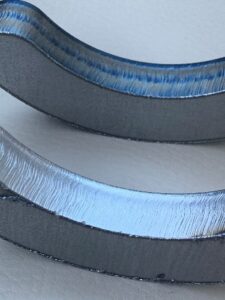
In this photo, the part on the bottom is cut with pure nitrogen assist gas. The burr is slightly greater and the cut speed is slightly slower, but the part edge is shiny – showing a lack of oxidation.
Mixed Gas Cutting
Mixed gas cutting adds roughly 2–4% oxygen to the nitrogen. Pure nitrogen relies on high-pressure gas to eject molten material from the kerf, which can leave significant burr as material thickness increases. Adding a small amount of oxygen helps burn away much of that burr and kicks up cut speed even a bit more, producing a cleaner edge with little or no secondary deburring required.
Mixed gas is generally recommended for cutting mild steel above 14-gauge (~0.1”) in thickness. Below this level the speed and burr will be similar for pure nitrogen or mixed gas cutting.
In this photo, the part on top is cut with mixed gas. The part has less burr and took about 5% less time to cut, but the edge has a notable bluish hint – showing some slight oxidation.
Compressed Air Cutting
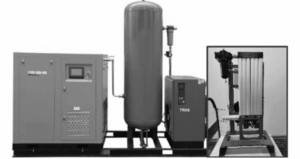 Since air is predominantly nitrogen, compressed-air cutting falls under the umbrella of nitrogen-based cutting. Its biggest advantage is cost: instead of purchasing nitrogen or a nitrogen generator, the shop generates assist gas on site. The air must still be carefully prepared to remove moisture and particulates, so a special system similar in appearance to a nitrogen generator is required.
Because air contains just under 21% oxygen, it produces a darker surface color than pure nitrogen or mixed gas, but can still provide high cutting speeds and good edge quality when a completely oxide-free edge is not required.