Why is Chuck Design Important on a Tube Laser?

The Short Answer

On a high-speed tube laser, the speed and acceleration of the chucks dramatically impact overall part cycle times. On these machines, only two chucks are used and they are designed to be lightweight, quick, and maneuverable.

On large profile lasers, the primary objective is supporting massive weight over long lengths. These three and four chuck machines are designed for high weight capacities and allow for zero-scrap cutting.

High-Speed vs. Large Capacity Chuck Design

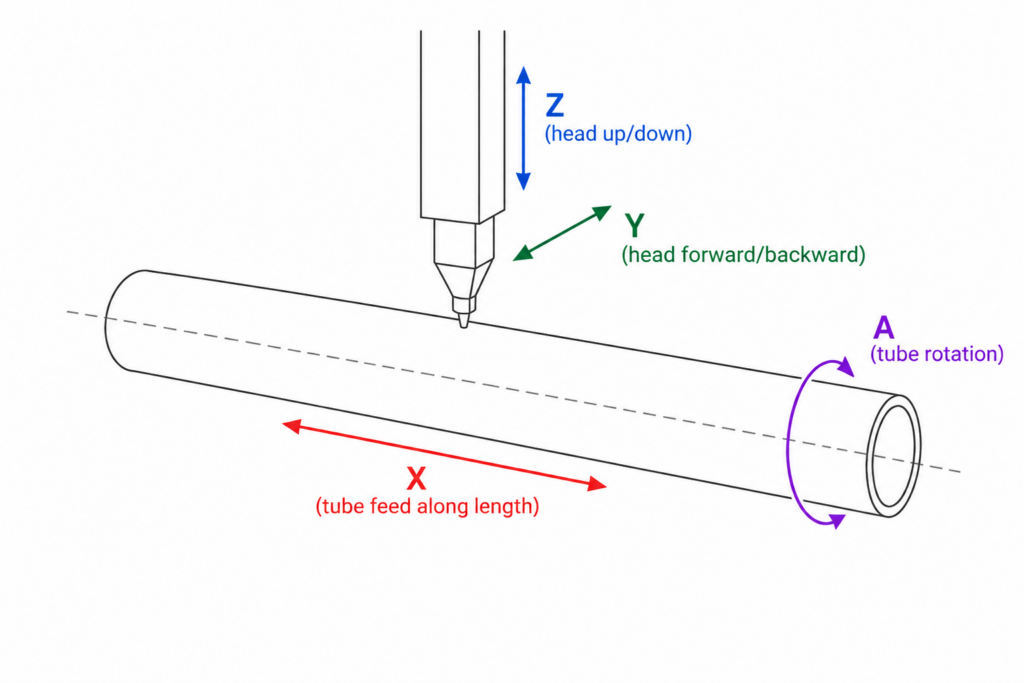
Tube cutting is a four-axis system, as seen in the diagram shown here. While insufficient power can certainly impact cycle times, it is rotation of the material (A-axis) that most impacts cycle time.

In high-speed cutting, the chucks are designed to be lightweight for maximum rotational speed and acceleration. These chucks can handle limited weight but are fast enough to outpace the speed at which the laser itself can cut. On these machines, head dynamics, chuck dynamics, automation and laser power all play significant roles in overall productivity. Comparing machines by specification is almost impossible, making cycle time studies the only true method of comparison.

In large capacity and structural tube cutting, the weight of the material is so significant that movement along the X and A-axis is significantly hindered. The chucks are heavily reinforced and the larger the required capacity, the slower the cycle time. For large capacity machines, specifying the right machine is a balancing act between maximum capacity and productivity.

Mechanical vs Pneumatic Chucks

Since chuck dynamics are key for both speed and capacity, understanding chuck design is important. Chuck designs break down into two styles, mechanical and pneumatic. Both designs address the core issue – clamping force needs to be applied and maintained while the chuck rotates.

Pneumatic Chuck Design

Pneumatic chucks remain the standard design and ideal choice for large capacity machines. Pneumatic force is applied to hold the material within the jaws while the chuck is not rotating. Then, a valve is closed and the air supply is disconnected. The chuck is then free to rotate while pneumatic force is retained by the air pressure sealed in the chuck.

But the great shortcoming of this design comes down to leaks. Worn valves or air lines can leak pressure over repeated use. The good news is advanced systems will sense a loss of pressure and pneumatic components are easily replaced when worn.

Mechanical Chuck Design

Mechanical chucks function as a cam-ring actuator. A ring is pushed forward around four clamping jaws. As the ring moves forward, the jaws are forced closed and when the ring moves back, the jaws open.

This provides two significant advantages over pneumatic chucks. First, the jaws are forced to close in unison – making this chuck “auto-center” by design. Second, the chuck is free to spin against the clamping ring, but the air pressure is never cut off. Instead, the ring applies force consistently while the chuck rotates. This “mechanical” design has less maximum clamping power but is employed on premium high-speed tube lasers for its lightweight design and improved reliability.

Two, Three or Four Chuck Designs

Tube lasers come with two, three or four chucks. Each has an intended use case and drawbacks. In all cases, the chucks rotate in unison.

Two-Chuck Designs

Tube lasers with two chucks are simple. Both chucks are on the loading side. One grabs the back of the tube and the second supports it right before the cutting area. They advance the tube longitudinally and rotate in unison, allowing cut parts to freely drop in the unloading area.

Two-chuck designs are optimal for high-speed tube lasers. The additional support of a third chuck is not needed for light tube and the minimized weight allows for the quickest possible movement.

Since two-chuck machines grab one end of the tube throughout processing, that material at the end of the tube is always scrapped. There is no way to cut that last bit of material while maintaining stability.

Three-Chuck Designs

Three-chuck designs are required on large profile tube lasers because they add another support point over the length of long and heavy tube. The floating tables and rollers common to high-speed tube lasers are insufficient to support a bowing I-beam. Designed to move significant weight, three-chuck systems move much slower than two-chuck.

On high-end tube lasers, this third chuck also has a second purpose – zero-scrap cutting. At the end of a tube, the third chuck is no longer needed for support and is able to cross over the cutting envelope and grab the part from the unload side. This allows the first chuck to release and that last section of tube – typically scrapped with a two-chuck laser – is available to be cut.

Four-Chuck Designs

Four-chuck designs add another support point and can be advantageous when processing extremely long or heavy structural profiles. The fourth chuck also speeds the zero-scrap cutting process, as none of the chucks need to cross the cutting envelope.

The drawback is that structural material is rarely perfectly straight. Square and rectangular tube can arrive bowed or twisted, and adding more rigid clamping points forces the machine to constrain those imperfections across a longer section of material. Rather than simply supporting the tube, the chucks can begin fighting the natural shape of the material as it feeds and rotates.

Those forces are transferred into the chuck jaws, bearings and drive components. On very heavy profiles, the resulting loads accelerate chuck wear. For this reason, Fairmont only uses four-chuck designs on its largest structural tube lasers – where the extra weight capacity is a requirement. We prefer a three-chuck architecture that provides the support and zero-scrap capability required for heavy structural cutting without unnecessarily over-constraining the material.

Author: Alex Burnham, Senior Product Manager, Fairmont Machinery
Technical Review: Chip Burnham, Owner & CEO, Fairmont Machinery
Last updated: October 2026