What Laser Power is Optimal for my Tube Laser Application?

The Short Answer

Tube-laser power should be matched to wall thickness and tube geometry, not simply maximized. While higher power still results in shorter cut times – tube laser cycle times are more impacted by machine dynamics than flat laser, and too much power can damage the opposite wall of a tube.

Generally speaking, those running thin-wall or small-diameter profiles should consider 6 kW with a possible upgrade to 12 kW. Those running thick wall or large diameter profiles should consider 12kW with a possible upgrade to 20 kW.

Assist Gases & Power Still Matter

While tube lasers typically range from only 3 – 20 kW, the rules of assist gases still matter. Nitrogen-based cutting will be much faster, while oxygen cutting allows for thicker cutting and less chance of damaging the opposite side. Learn more about assist gases in laser cutting here and the relationship between power and material thickness here.

Like with all laser cutting, the goal is to cut with nitrogen-based assist gas. The cut is much faster with almost no taper or heat-affected zone. Given the difficulty in deburring the inner diameter of tube parts, mixed gas (or sometimes air cutting) is recommended over pure nitrogen because the addition of oxygen tends to burn off some or all of the burr. For those particularly concerned with burr inside the tube, stepping up in power will provide a cleaner cut without needing to move to oxygen.

Burn-Through Consideration

Fairmont RevolutionT Anti-Burn Through OptionHere is where tube cutting becomes more complex than flat. In flat laser cutting, more power = faster. In tube laser cutting, power is limited by potential damage to the opposite wall of the tube.

A large diameter tube with a 1/8″ wall would benefit from the speed and cut quality of a 12 kW laser. But a small diameter tube with a 1/8″ wall would be forced to drop power to avoid damaging the opposite wall of the tube. So, on large format tube lasers, power can be almost as valuable as in flat laser cutting, whereas on small diameter tubes and profiles, power typically stays between 3 and 12 kW.

Tube lasers often have an option to add a burn-through protection mandrel. While the primary function of this add-on is to reduce splatter on the inner diameter of the tube – particularly from nitrogen-based cutting – it also can slightly increase the power available on smaller diameter applications.

Machine Dynamics

Much like flat laser cutting, power improves cycle times until machine dynamics (speed, acceleration) gate cut speed rather than power. In tube laser, however, those machine dynamics are far more complex and less intuitive than flat lasers.

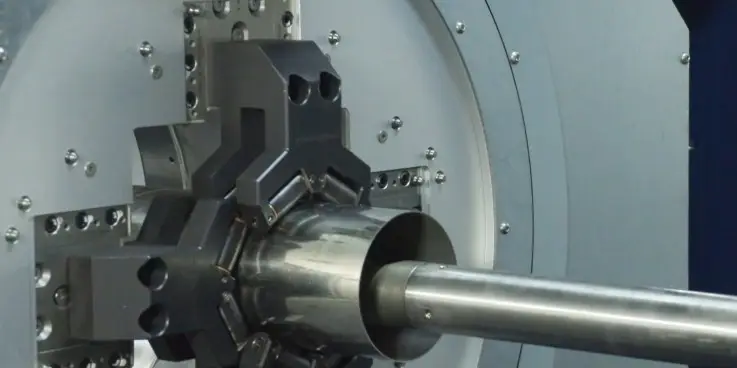
While material lies still on a flat laser, tube lasers must be constantly changing the presentation of the material to the laser. Two or three chucks work in sync with the cutting head to negotiate a cutting path – requiring almost constant acceleration changes along multiple axes.

As a result, it is very rare that the tube laser will reach its top speed. And since the machine rarely reaches its top speed, power is rarely limiting cycle time.

The challenges in machine dynamics also split tube lasers into two groups: high-speed and large capacity (learn more here). Machines with larger chuck capacities and higher material weight limits generally have lower motion dynamics and longer part cycle times than machines with lighter chucks and lower capacities.

The Place for High-Power

Large-format and structural applications are where high-power tube lasers provide the greatest advantage. At corners, intersections and other areas where the effective wall thickness increases, higher power can maintain cutting speeds while allowing nitrogen-based cutting for faster, cleaner results. Large-diameter tubes and structural profiles also reduce the risk of damaging the opposite wall, making higher power more practical.

For these applications, bevel cutting is also commonly available to address the needs of the structural steel market.

Ultimately, the right tube laser is not necessarily the one with the highest power. The best combination of laser power, tube capacity, machine dynamics, assist gas and burn-through protection is what determines real-world productivity. The goal is not simply to have more power—it is to have the right power for the material, geometry and production requirements.

Author: Alex Burnham, Senior Product Manager, Fairmont Machinery
Technical Review: Chip Burnham, Owner & CEO, Fairmont Machinery
Last updated: October 2026